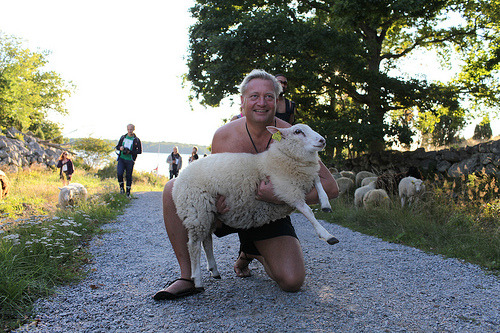
I wish! (via Jonas)
I saw Chris Anderson at Media Evolution in Malmö the other day (along with everybody else). I liked it, and it made me think.
A thought: does free work in the long tail?
I’ll try to keep this short.
If freemium works by letting 90-something percent get the content for free, and the remaining percentage pay for everyone, the site has to have a certain number of visitors to make any business viable. That number will vary depending on the cost of the site. But is there a lower number of visitors which simply can’t create enough revenue for any business to survive?
If this is the case, freemium doesn’t work in the long tail. And in a further perspective, perhaps freemium will have difficulties in any market with a limited amount of potential users – measuring by language, interest or any other parameter.
An example: Erik the entrepreneur runs a website with a freemium model in Sweden. A Swedish full time salary costs a company about 500 000 SEK a year, with taxes and all. Say that a typical premium product (Flickr Pro, or similar) costs 300 SEK a year.
This would mean that a freemium model would require him to have 1666 paying customers a year, just to pay his salary. With a payment rate of 5% that would mean that he needs 33 320 visitors regularly to break even, without counting any costs. For Sweden, that’s quite a lot of visitors, placing him a bit up in the tail.
Apart from cutting salary and all of those arguments (not relevant as these are hypothetical figures anyway) – could it be so that there is a limit, somewhere down the tail, where freemium simply doesn’t cut it? At least not as a business model.

My old dad and his photos (via david.jeffery)

My old dad and his photos (via david.jeffery)
It’s been a long and tough week, and the weekend is looking to end in a not-so-good way either as I’m feeling a bit sick. But I feel I must write a few lines about an amazing event that I took part of this week.
I am, of course, talking about 24 Hour Business Camp that took place at Hasseludden Yasuragi, just outside of Stockholm. If you are not familiar with the event you can read up on it here. There has been so much media coverage of the event that one might think there is nothing add. Therefore, I wrote a few notes on the event from a more corporate perspective.
Firstly, the event shouldn’t be evaluated by what was created, but what can be created. Sceptics have noted that it is unlikely that many of the projects will amount to a real business. Be that as it may, but it is irrelevant if they do or not. Why would anyone – no matter the time frame – declare a business finished, ever? Running a business is a process. It always has been, and it always will be. Therefore the interesting parameter to look at is how much can be done in a mere 24 hours. A lot, judging by the projects delivered.
In the companies that I work with, product development cycles are long. Often several months. A lot of the time is spent making sure that all the stake-holders agree with the projects main idea, and making sure that it will be well received once it is finished.
Although time consuming – and often frustratingly slow – this process is not to be underestimated if you want the project to become successful. But keep in mind that this process only is needed when launching a project that is going straight into the operations of a large company.
The way I see it, the 24 Hour Business Camp projects should be classified as the things that precede such a process. The experimenting. The prototyping. The testing. The things that can give the projects stake-holders enough faith and proof that this is a viable project idea. After that, we can get started. Sometimes the project will have to be completely re-written, in other cases the 24 Hour mock-up is good enough to launch straight away.
Whether it works or not, or can be used straight away or not, is not important. Such criticism simply shows people´s lack of seeing progress through anything else but an immediate success. This is a very naive way of looking at any type of development.
What can we learn from failure? Loads, but let’s try a few examples: We can learn that the concept was entirely wrong, because nobody understood it. We can learn that the idea was good, but that specific way of executing it wasn’t very efficient. We can learn that a failure within the the area that we set up may well become a success in one that we hadn’t thought of. Learning any of these things after 24 hours of work is to be regarded as extremely cheap, and effective.
There are so many factors that precede a successful business. I think many companies could learn a lot from 24 Hour Business Camp when it comes to finding out these factors.
Disclaimer: I participated at the event for one of our clients, Bonnier R&D. Together, we produced a small RFID-project that you can read about here.
It has nothing to do with anything, but I was very happy when I found out that I was one of Medievärlden´s seven “Media Profiles” for 2009. Below is a PDF with the picture and short interview that was featured in their January issue.
http://www.newsmill.se/millord/Newsmills%20mill%2Dwidget
Trying out Newsmills new widget!
I’m glad you’re still here. The site has changed as you may have seen. If not, then you are reading through RSS and hopefully nothing has changed at all 🙂 Either way the colour profile is a bit off so far, but we’re getting there. Hold tight.
One of the things I’ve been thinking about is whether I should keep writing this blog in English or not. The rest of our site is now in Swedish so it might make sense to switch. Maybe stick to Twitter for English updates? I’ve got a feeling mostly Swedish people read this anyway. What do you think?
Please speak up as I’m trying to get organised for this years blogging. There’s going to be a lot of things to write about!
You must be logged in to post a comment.