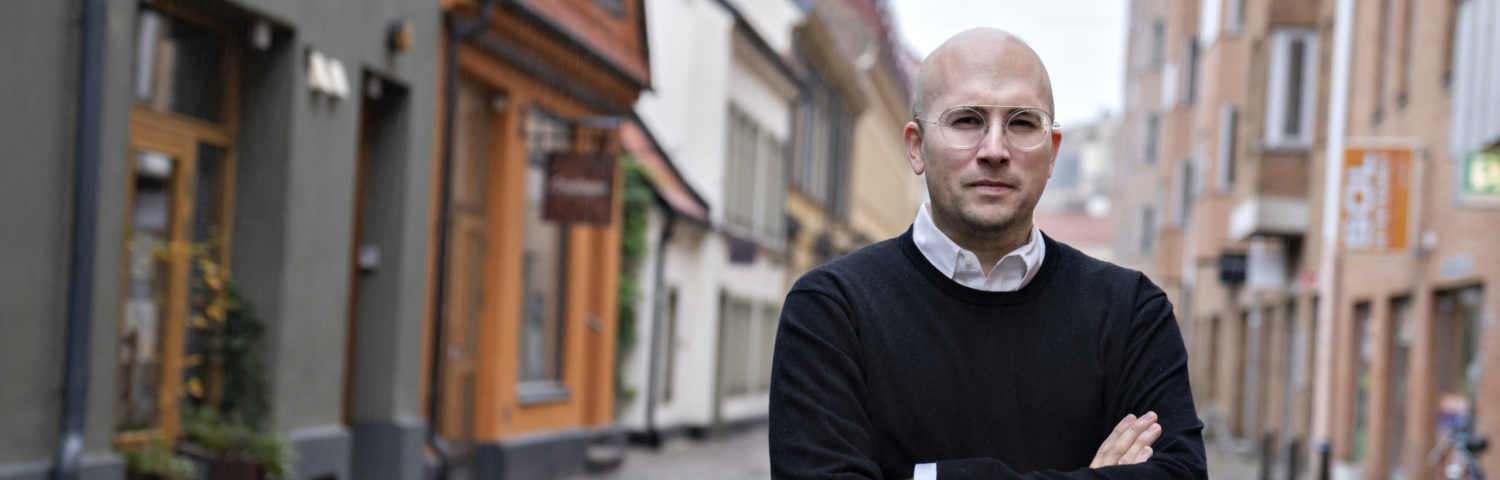
Moving Images 2007 – Andy Quested, BBC

Good Old Trend

I’m at Malmö Högskola where the third Moving Images conference is taking place, organised by SVT (Swedish National Television). The theme for this year is HD and high resolution. I thought I’d live blog chosen parts of it.

SVT:s CEO Eva Hamilton introduced the day by emphasising the importance of both audio and visual when it comes to HD. Far to often it is assumed that it is only a matter of picture quality. The HD development is one of SVT:s prioritised projects, along with on demand services. In 2008, the plan is to offer HD programmes between 18-23 every day. Interesting.

Andy Quested, responsible for HD strategy, from the BBC started by apologizing because the presentation was in English, that he was going to use Powerpoint and the first audience activity of the day. Everyone in the hall had to stand up, and only those with HD at home were allowed to sit down. 99% of the audience were still standing. Quested said, “How can we understand are audience if we don’t know what they are watching”.

So why is HD important now? The three points listed were:

1. Production technology – finally here, this has taken slightly longer than expected.

2. Consumer devices & flat screens – selling very well to consumers

3. Delivery technology – works today

These three all lead to the fact that HD services now are affordable, Quested said. And he consumer demand is what’s driving the market:

* Prices fell by 30-40% over the last year
* Consumers can get HD quality through many different sources – PS3 and similar devices.
* Competitors like Sky have driving the market forward.

Some stats:
Britain: 3.8 million HD-ready TVs (March 2006). Expected to hit 10 million in 2008.
Japan: 9.6 million HD TV sets, 19 channels broadcasting (end of 2006). 28,9 millions HD TV sets and 69 channels predicted by 2011.
US: 27.7 million sets, 42 channels. There was a prediction here as well, but unfortunately I missed it.

The BBC had made a survey to see where the HD technology gave an perceived benefit in the programmes. Wildlife, Sport and Film came out on top, while History and Comedy where in the bottom. Quested had examples where old comedies from the 70´s and 80´s that were still sent successfully, even if it was 4:3 and bad quality. The genre seems to be less sensitive to audio/visual standards.

Quested took up an interesting point regarding quality control. 1280×720 images (except the Varicam and HDX900) simply aren’t good enough. And this is because the material shot can’t be reused, or resold later on. Some of the nature programmes that are filmed today will have an even higher value further on, as the areas filmed now are off limits for media, and some of the species are extinct. Although, the scenes will probably be sold and used in small chunks, rather than full programmes. Makes sense.

tags technorati :

tags bloggar.se: , , , , ,

From Gatekeeper to Curator

Good Old Trend

I’ve been meeting with a lot of journalists lately, discussing the new role of journalism and media. My presentation at Hej!2007 and Reboot9 takes up the issue, but I thought I’d lift out one statement which really says it all:

Journalists need to go from being gatekeepers to being curators.

Old Media have been holding people and their stories out for ages. When I worked at Sydsvenskan, we had a person that only worked with keeping in contact with the readers. Sounds like a good idea. But often enough, the job was to keep people away from the journalists in question. Sometimes getting leads, but then following them themselves. A classic gatekeeper.

Let’s look at the opposite. Imagine an art curator running a gallery for instance. You don’t go to the gallery because you necessarily know the artist exhibiting, but you trust the curator enough to go anyway. You respect his/her taste and choices enough to check it out.

Today, what old media has is a brand which is (hopefully) filled with trust and credibility. This compared to your average blog at least. I think they need to leverage that trust and start becoming the hub about what’s going on in the world, rather than having to report about it themselves. If the newspaper says that a certain blog has a good post on the issue, people will click to read it. They could find themselves, but only with great difficulty and without guarantees of finding anything worth while.

A new type of journalism is evolving. Picking out the best stories, pictures, videos and anything else being produced – and then editing it together into a new piece. Adding context, background and analysis. If they start having that approach, I think old media is going to thrive in this information filled society.

tags technorati :

tags bloggar.se: , , ,

Reboot9 presentation

Good Old Trend

At Reboot9. Loving it. Don’t want to blog too much in order to focus on the presentations. Olof is doing a good job of it though, head over there instead.

I had my presentation yesterday. The Box Room was extremely hot and noisy, but it went okay I think. The topic was Old Media vs New Media: news narcissism and the end of having anything in common. If you missed it the slides are here below:

tags technorati :

tags bloggar.se: , , ,

Going -> Reboot9

Good Old Trend

After a great day in Stockholm yesterday I’m off to Copenhagen and Reboot. I suggested a presentation but instantly got some negative feedback regarding choice of topic (the same one I had at Hej!2007). I guess if there’s any conference where it would be okay to be called out as “so last season” I guess it would this one 😉 Either way it looks like I’m holding it anyway, so please feel free to drop by and join the conversation.

The whole Good Old gang are going actually – all nine of us. Could be really good! Last year’s meet up was one of the highlights of the year.

tags technorati :

tags bloggar.se: , ,

INJO day three – Douglas Engelbart

Good Old Trend

douglasengelbart.jpg

Douglas Engelbart is a legend, and one that laid the foundation for his genius in the most impressive way I’ve heard in a long time. Perhaps ever, actually. At the age of 25, he took a few months to try to straighten out what he should be doing the rest of his life. What he realised was that if people don’t get better at collectively using their resources in order to get forward – the world would ultimately crash. So he put together his lifetime goal from this insight, and phrased it like this:

As much as possible, to boost mankinds collective capability for coping with complex, urgent, problems.

This then became the driving force behind his work, and life, for 55 years and counting. _Wow.

Engelbart spoke calmly and with a very humble approach. Today, many of the ideas presented are obvious and integrated in society and systems. Therefore a simple analysis would have been “heard it all before“. But this is where it started. From the beginning. I found it a bit difficult to keep that perspective in mind.

He stated that solving any truly large-scale problem requires collective capability. And in order to do this, one must develop an adequate comprehensive understanding of the following:

The problem situation
The possible solutions
The resources required
The resources available

Engelbart called the way of approaching this the Collective IQ. He also added that the augmentation model was valid over a very large scale, following this logic:

Individual human – Operative IQ
Community of Practise – Collective IQ
A Complete Company – Collective IQ
The World – Collective IQ

At times, the presentation was very abstract and hard to follow. Or at least to summarise in an easy way. Someone more skilled would definitely done it better. Check Technorati to see what others are writing.

tags technorati :

tags bloggar.se: , ,